Your history built your career. Your present can build their future.
Mobilising school alumni networks to seed high-quality STEM education in Gauteng township schools.

Funded by you. Owned by us. Built for the next generation of Black excellence.
Talent is evenly distributed. Resource-heavy STEM education is not.
Gauteng township schools face persistent shortages of qualified STEM educators, functional laboratory infrastructure and reliable power. This blocks high-potential learners from achieving the bachelor passes needed for engineering, technology and medical careers.
Educator shortages
Too few specialist Mathematics and Physical Sciences teachers.
Power disruption
Municipal grid failures interrupt already limited learning time.
Infrastructure gaps
Laboratory and digital teaching tools remain out of reach.
A co-extensive hub-and-spoke learning network.
One central broadcast studio connects master STEM educators to four localised township centres, with resilient power, connectivity and in-person facilitation.
Live broadcast studio
Master educators deliver CAPS-aligned lessons from Johannesburg using multi-camera arrays and interactive smartboards.
Explore the modelTownship learning centres
Each host school supports up to 250 learners with projectors, audio, dual-SIM 5G, solar backup and trained local facilitators.
See the centresA focused Gauteng footprint designed to prove the model.
The initial pilot supports learners across Soweto, Tembisa and Alexandra township clusters.
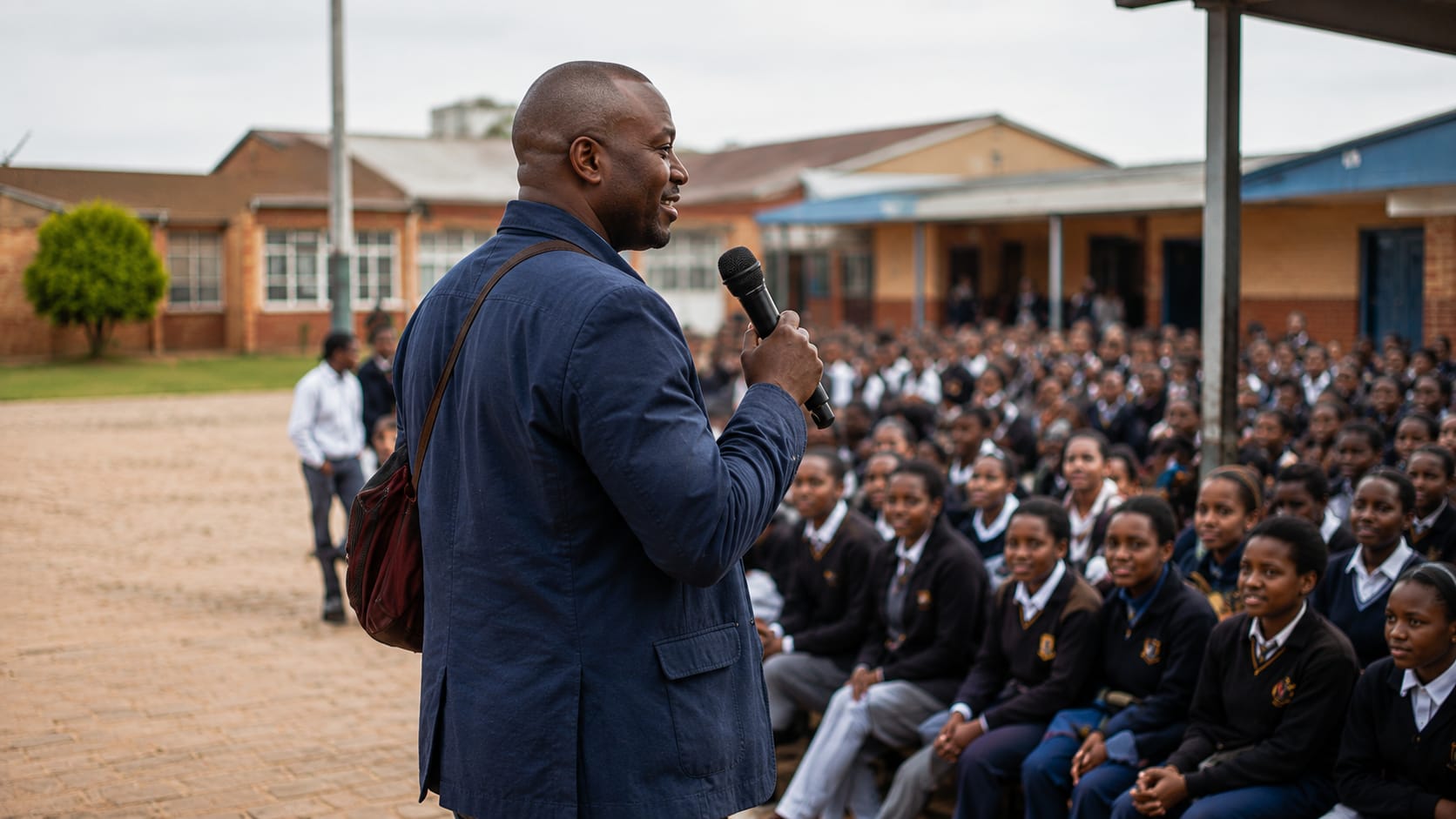
The people who walked these halls before can now protect the pipeline.
Alumni Impact bypasses dependence on volatile CSI grants and overstretched public budgets. Predictable monthly contributions are ring-fenced for the school communities donors choose.
- Private impact dashboard
Track attendance, curriculum coverage and term-to-term academic improvement. - Mentorship matching
Connect professional experience to Grade 11 and 12 learners. - Alumni leaderboard
See how school chapters rank on funding participation and learner outcomes.
Every R250 has a defined job.
The centralised architecture covers transport, nutrition, teaching, printed materials, connectivity and solar upkeep.